
Using humor to teach systems thinking.
Each episode builds a principle practitioners can actually use.
Why a cartoon series?
My technical papers make the case for the Innovation With Trust framework with data, models, and formal methodology. But not everyone reads technical papers.
The Adventures of AI Guy is for the person sitting in the boardroom being sold the next framework -- the person who intuitively feels something is wrong but doesn't yet have language for it. Each strip gives them that language in thirty seconds.
Most AI cartoons either celebrate the technology or mock it. This series does something different -- it uses humor to teach systems thinking. That is a niche very few people are occupying, and it is consistent with everything we are building around Innovation With Trust.
The Adventures of AI Guy™ · Innovation with Trust™ Editorial Cartoons
www.ratio-weekly.com
A coherent body of work.
Not isolated opinions.
The series builds from satire to philosophy. Each episode articulates one principle -- principles that practitioners can apply in real organizations on real decisions.
The concern it addresses runs deeper than any single technology. For decades, organizations operated deterministic systems -- ERP, CRM, rules-based automation -- where the same input reliably produced the same output. Those systems were auditable, predictable, and accountable. The move to AI-based systems is a fundamental shift in kind: from systems that are always right to systems that are right on average, and potentially wrong on any specific case or transaction. Most organizations have not yet reckoned with what that shift actually requires of their people, their governance, and their business cases.
The risk is not that AI thinks better than humans. The risk is that outputs which are statistically plausible get treated as epistemically authoritative -- quietly shifting judgment from accountable individuals to systems that aggregate patterns, not truth. Whether the system is a large language model generating strategy memos, a predictive model scoring credit applications, or a cascaded agent pipeline processing customer orders, the governance challenge is the same: who is responsible when the average is right but this transaction is wrong? That question does not answer itself. It requires practitioners with the judgment to ask it.
None of this makes us anti-AI. Quite the opposite -- it's the business we're in. But our starting point isn't the technology; it's competitive advantage. That distinction matters: a techno-centric approach starts with what the model can do and looks for places to apply it. We start with the human system already doing the work, and ask what combination of people, process, and technology actually strengthens it. Get that combination right -- and pair it with the organizational change management that goes with it -- and the transition to AI stops being disruptive. It becomes simpler, more durable, and genuinely competitive.
Clean Data Isn't Always
Predictive Data.
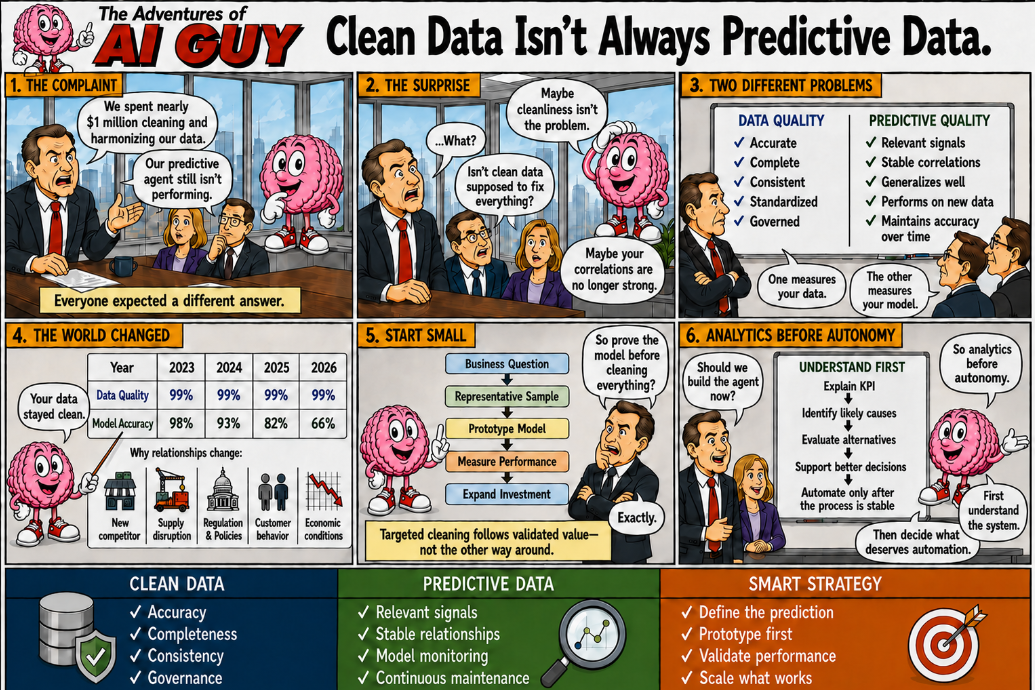
I recently had conversations with several CIOs and a consultant who had reached the same conclusion after attending vendor presentations.
They were convinced that once enterprise data was cleaned and harmonized, the AI models would be ready to deploy into their business processes. I suspect many organizations now share that belief. My response: maybe it would be ready -- but maybe it would not.
Clean data is essential, but cleanliness alone does not guarantee that your data contains a strong, stable predictive signal. Whether you are forecasting a KPI, detecting anomalies, classifying events, or anticipating customer behavior, model performance depends on meaningful relationships in the data.
Before spending millions cleaning everything, start with the business question. Select a representative sample, clean what is necessary, build a prototype model, and measure its performance. Find out whether the predictive value exists before expanding the investment across the enterprise.
There is a second failure mode, and it shows up later. A model can pass every test at launch and still lose accuracy over the following years -- not because the data degraded, but because the world did. New competitors enter. Supply chains reroute. Regulations change. Customers behave differently. The data stays clean by every governance metric you have, while the relationships that made it predictive weaken underneath.
Modeling also provides value beyond prediction. It can reveal relationships, suggest plausible explanations, and identify causal hypotheses worth investigating. It does not prove causation, but it can provide a much better starting point for understanding what is actually driving performance. If the model performs well, generalizes to new data, and rests on relationships likely to remain stable, then broader data preparation and deployment into an agent, RPA workflow, or other automated system may make sense.
Define the question. Test the signal. Understand the system. Watch the signal. Then automate.
Clean data is not always predictive data.
Analytics before autonomy. Understand the KPI, identify likely causes, evaluate alternatives, and support better decisions first. Automate only after the process is stable.
Actionable Analytics —
Why Good Dashboards Still Fail.
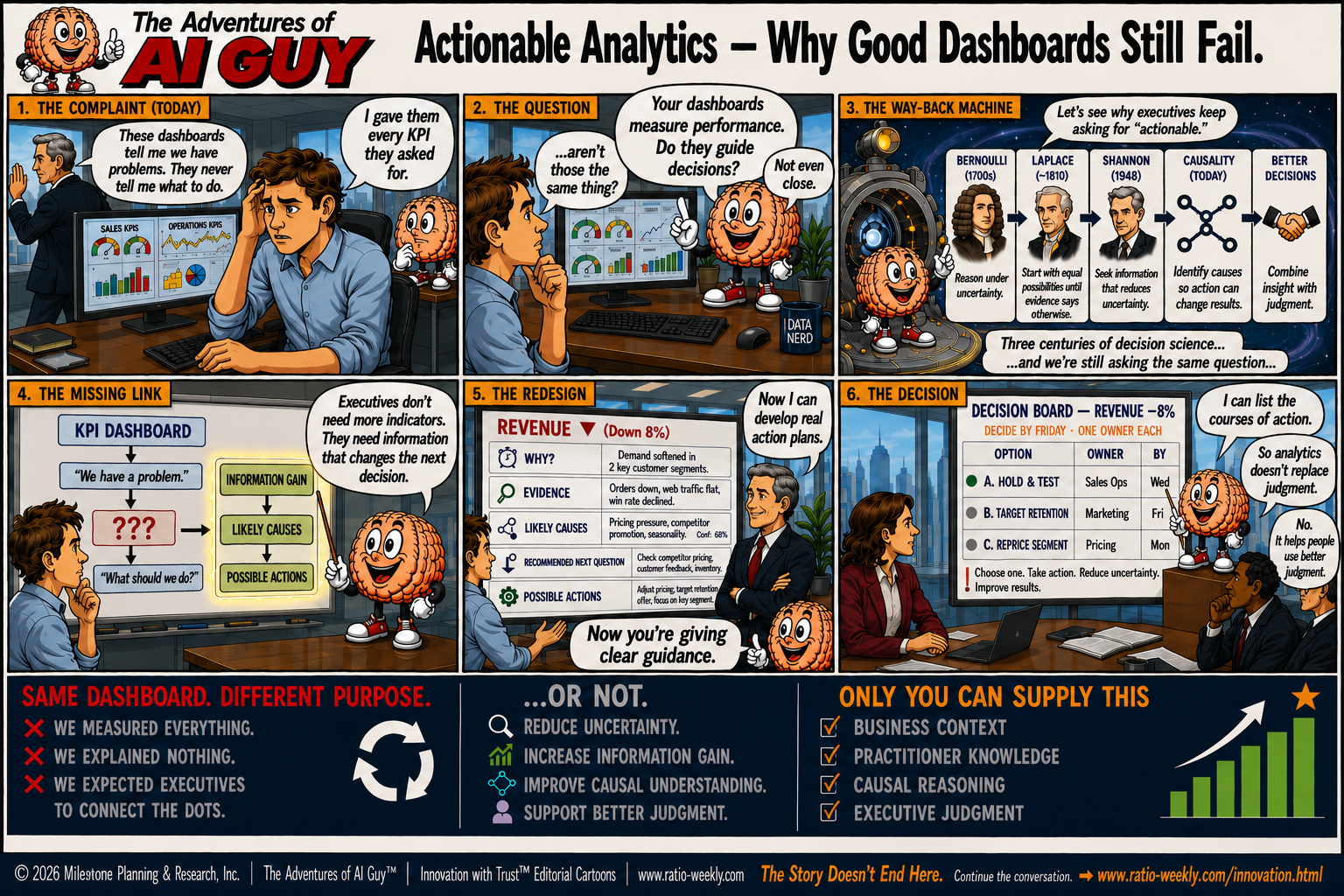
"These dashboards tell me we have a problem. They never tell me what to do."
Most executives have said some version of that. The usual response is predictable: another KPI, another drill-down, another report. But it isn't a data problem. Most organizations already measure more than they can act on -- revenue, margin, schedule variance, defect rates, customer satisfaction, and risk.
A dashboard tells you what happened. An executive needs to understand why it happened, what can be done about it, and which course of action is most likely to improve the outcome.
That challenge didn't begin with artificial intelligence. For more than three centuries, decision science has been trying to answer the same question. Jakob Bernoulli showed how to reason under uncertainty. Pierre-Simon Laplace formalized probability. Claude Shannon demonstrated how information reduces uncertainty. Ronald Howard later added the missing insight: information has value only if it changes the decision you would otherwise make.
That's the difference between reporting and actionable analytics. Executives rarely act because a gauge turns red. They act because they understand the likely causes, the evidence supporting those causes, the uncertainties that remain, and the realistic courses of action available to them.
Good analytics shouldn't stop with explaining the past. They should expand the decision space. Instead of presenting a single answer, they should identify credible alternatives, expose their tradeoffs, and help decision makers evaluate the consequences before committing to a path.
Sometimes the best decision isn't the first one anyone considered. It's the one that emerges after exploring alternatives that were hidden until the evidence was assembled.
AI can estimate probabilities. AI can recognize patterns. AI can generate alternative explanations. AI can identify plausible courses of action that decision makers may not have considered.
The goal isn't to replace executive judgment. It's to ensure every important decision begins with greater understanding and better alternatives. The purpose of analytics was never to produce more dashboards. It was to reduce uncertainty, explain what is happening, identify credible courses of action, and help leaders make better decisions.
The value of analytics isn't measured by how much data it displays. It's measured by whether it helps people make a better decision.
Judgment: Human vs. Machine,
Or Human WITH Machine.
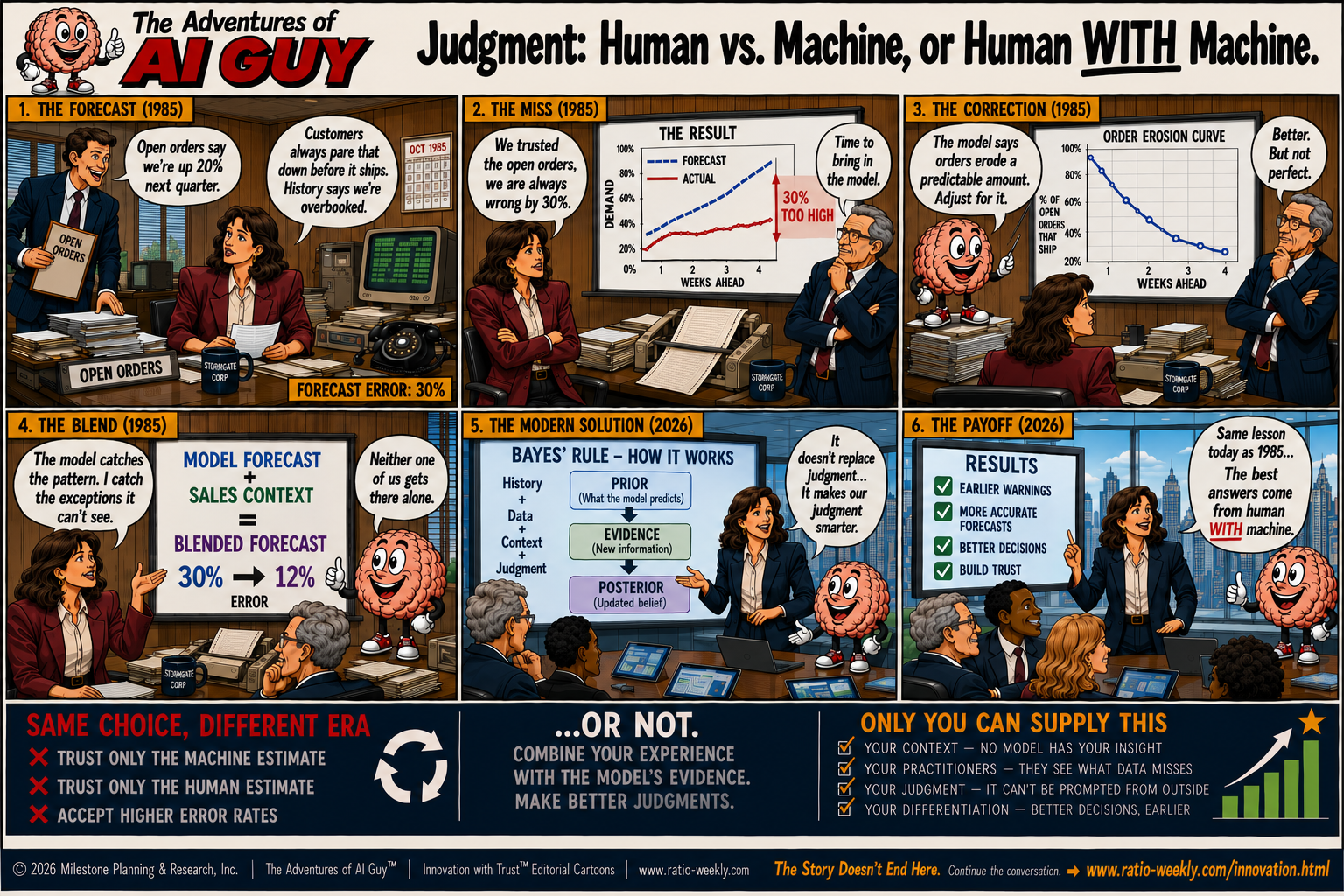
In 1985, I ran sales forecasting at an electronics manufacturer. Error rate: 30%.
The cause wasn't bad data or bad salespeople -- it was open orders. Customers reliably pared them down before shipment, and the forecast never corrected for it. We built a statistical model (today, call it ML) to learn the erosion pattern, include seasonality, and adjust for it. Better -- not enough. It assumed every account eroded the same way. It couldn't know that one customer had just signed a three-year deal, or that another was quietly about to cancel.
The fix: blend the model's history-based correction with the salespeople's account-specific read. Error rate dropped from 30% to 12% -- good enough to run the business on. At the time, we had no formal justification for why it worked. Just that it did.
This isn't a forecasting story. It's every ML prediction system running in production today -- regression, classification, or time series: demand forecasting, credit risk, churn, pricing, staffing. A model trained on history, sitting next to people who have context the model can't have, because it hasn't happened yet.
"Human in the loop" gets used as if it were a method. It isn't -- it's a location. It tells you a person is standing somewhere in the pipeline. It says nothing about how their input is combined with the model's, how much weight it gets, or whether that weight is earned or assumed.
In practice, "human in the loop" usually means one of two things: a person can override the model, or a person's number gets averaged with the model's. Neither is principled. An override throws away whatever the model got right. A flat average assumes the human and the model are equally reliable in every account, every period -- exactly the assumption that was failing us in 1985.
Weight each source -- model and human -- by its own demonstrated accuracy, tracked per segment, and let that weight shift as the evidence shifts:
1. Track the model's prediction error and the human adjustment's error separately, by segment, over a rolling window.
2. Combine the two predictions with weights proportional to inverse error variance -- the more reliable source gets more weight, automatically.
3. Recompute the weights on a cadence so the blend adapts as either source's reliability changes -- a rep's read gets more weight right after a major account event; the model's weight recovers once the account stabilizes.
That's it. It's auditable -- you can show exactly why the prediction landed where it did. Not "trust the person" or "trust the machine," but trust whichever one has been right lately, in proportion to how right it's been.
Structurally, this is the same logic underneath Bayesian updating: model output as prior, human read as evidence, posterior weight set by track record rather than instinct or a fixed split. Bayes' Rule has been around since the 1700s. What's overlooked is that it's a ready-made, auditable mechanism for melding human judgment with machine prediction -- not a new theory, just one rarely pointed at this problem.
And the failure mode worth worrying about isn't a hard error the system flags. It's a soft, systematic blind spot -- the model quietly wrong in the same direction, in the same accounts, for months -- that nobody notices until the prediction is already wrong and the business has already acted on it.
That's the difference between "we added a human in the loop" and a defensible, auditable methodology for combining human judgment with machine prediction.
History + data + context + judgment feed a prior (what the model predicts). New account-level information is the evidence. The posterior -- the updated belief -- is the blended prediction, weighted by which source has actually been right.
Bates & Granger (1969): weighting two forecasts by their own error track record -- not a fixed 50/50 -- beats either alone.
Blattberg & Hoch, "50% Model + 50% Manager" (Management Science, 1990): the combination beat model or manager alone across five real forecasting situations.
A 2023 Journal of Operations Management field study found the same result with a modern ML ensemble -- human input added the most value during COVID, when staff had context the model hadn't seen.
Historic Irony
How Human Relevance Saves AI from Itself.
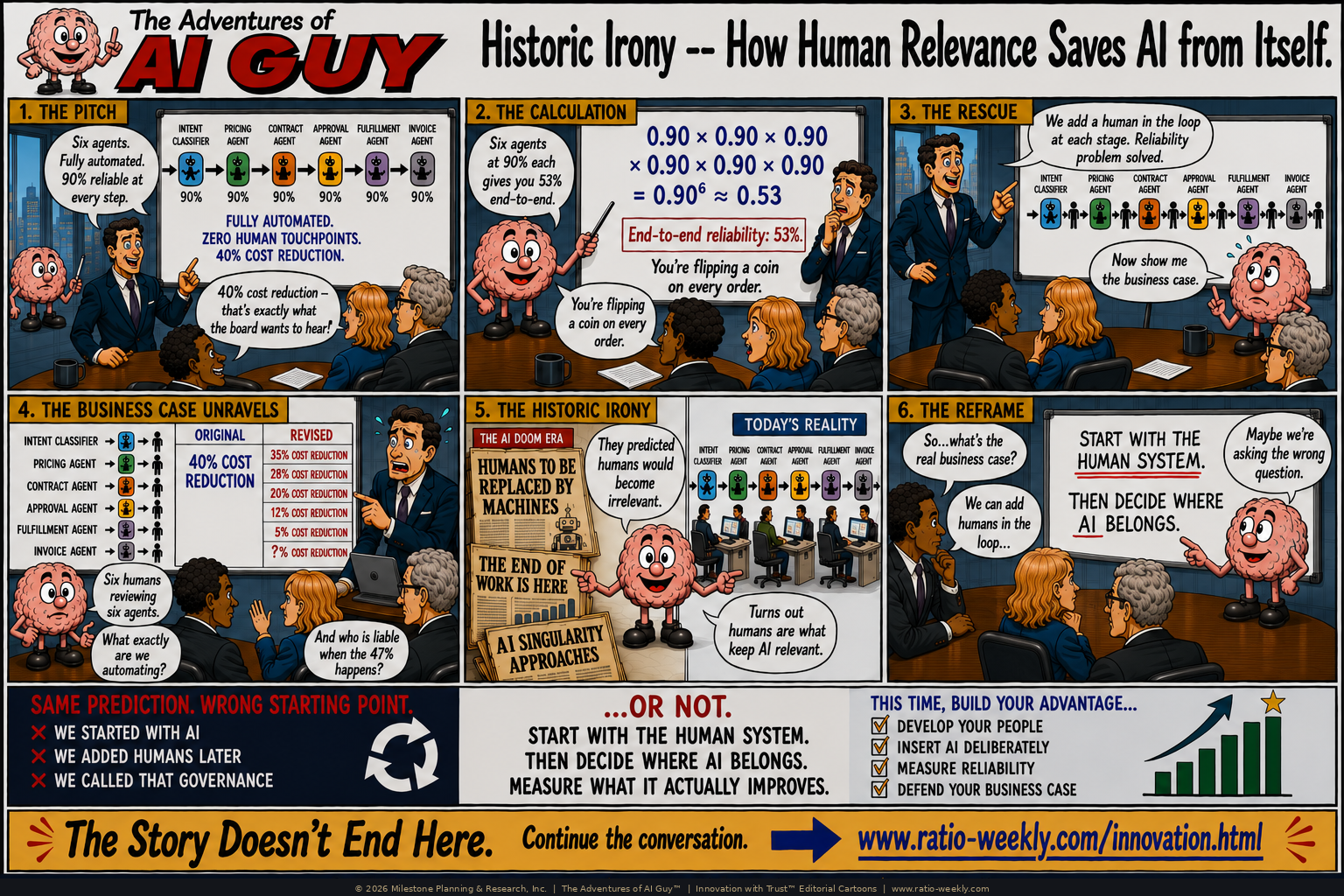
One of the great ironies of modern AI is that the more organizations automate, the more valuable human judgment becomes.
For years we were told AI would make people economically irrelevant. Geoffrey Hinton warned about these risks after helping create the technology. Yuval Noah Harari warned at Davos 2020 that those who fail the struggle against irrelevance would constitute a new "useless class" -- not useless to their friends and family, but to the economic and political system. Stephen Hawking warned about AI's long-term dangers. The WEF projected millions of jobs displaced and millions of new roles -- but the displacement story dominated. Over time that narrative shaped enterprise AI strategy: automate, reduce headcount, eliminate human touchpoints.
The problem is that the business case often overlooks a fundamental distinction.
Business AI is trained on historical data. Unlike engineering systems governed by physics -- where governing equations can generate synthetic data with near-deterministic behavior -- business systems are shaped by people, policies, competitors, regulations, and markets. They remain probabilistic, continuously evolving, and require ongoing monitoring, retraining, and governance. Those costs belong in the business case too.
AI may be highly reliable on average, but every decision still carries uncertainty. Chain six AI agents together in a quote-to-cash process, each operating at 90% reliability, and end-to-end reliability becomes:
The obvious response is to insert human reviewers throughout the workflow. Reliability improves -- but so does cost. Every human added back into the process reduces the projected savings. Eventually the conversation shifts from "How much are we saving?" to "What exactly are we automating, and what is the real return?"
Perhaps we've been asking the wrong architectural question.
That shift changes everything. Human judgment is no longer a weakness to engineer around -- it becomes the foundation AI is designed to strengthen. Governance becomes clearer. Accountability becomes easier to define. Competitive advantage returns to organizations that develop better practitioners -- not simply those that deploy more AI.
That's the historic irony.
Human relevance isn't disappearing. Ironically, it may become the very thing that makes enterprise AI trustworthy, governable, and ultimately valuable.
AI may be trustworthy on average -- across thousands of decisions -- but unreliable on any individual one. The model right 90% of the time is wrong one in ten. Design for the individual decision, not the average.
The doomsday narrative that shaped the vendor market -- AI replaces humans -- is being quietly contradicted by the mathematical realities of deployment. Human relevance is not the obstacle to AI adoption. It is the precondition for it.
Modal Salient
The Most Dangerous Two Words in AI.
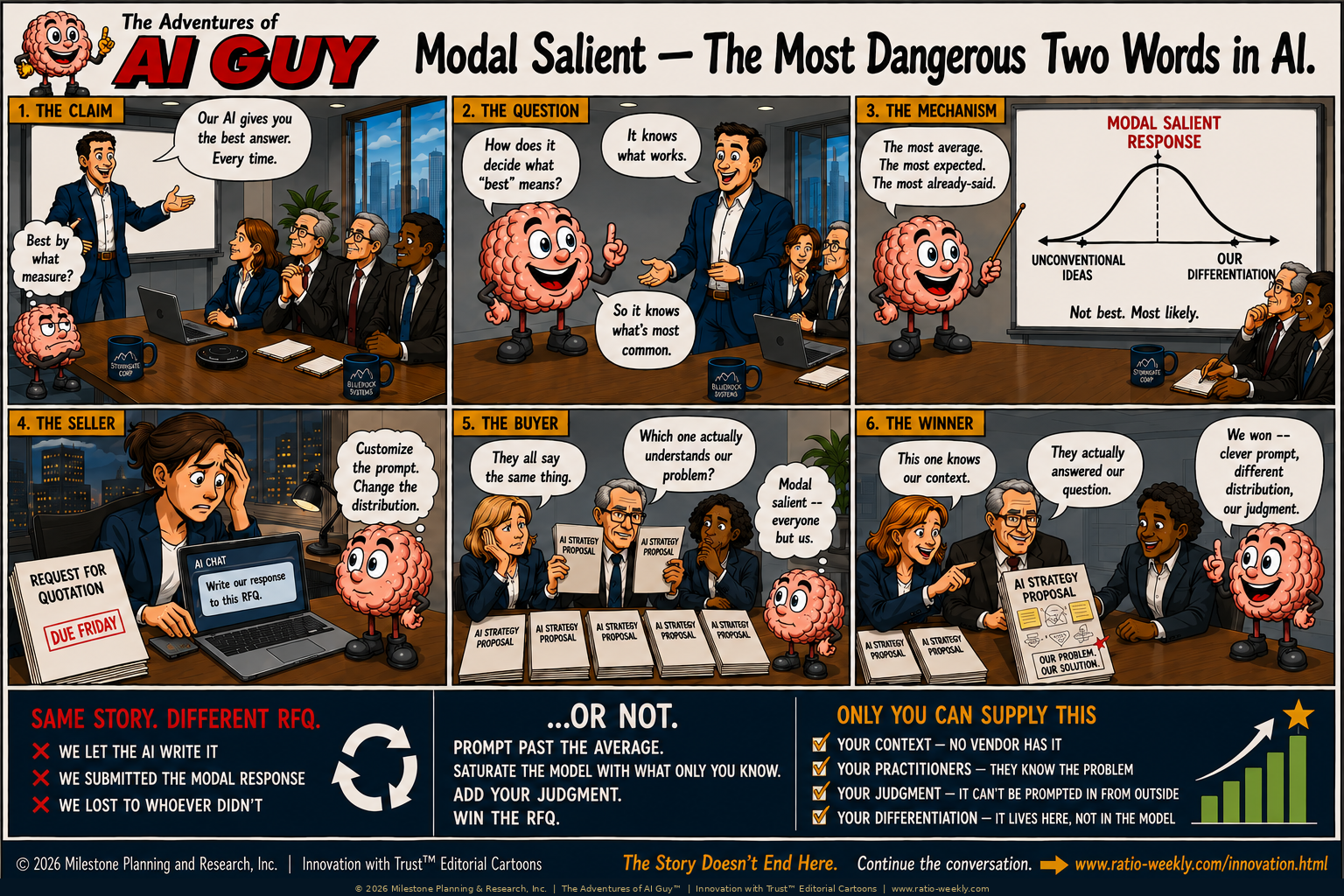
I've watched this argument evolve for twenty-five years.
In 2004, James Surowiecki published The Wisdom of Crowds and gave a generation of managers a powerful idea: aggregate judgment outperforms individual expertise. The book was correct, influential, and almost immediately misapplied.
The misapplication: "the crowd is wise" became "the most frequent answer is best." Benchmarking culture was already primed for it. Malcolm Baldrige, best-in-class thinking -- the entire quality era had conditioned organizations to treat peer consensus as a proxy for excellence.
Surowiecki's crowd works because its members are independent and diverse. The moment the crowd copies itself, the wisdom disappears. What remains is herding. The math still aggregates. But it aggregates sameness.
Now apply that to large language models. LLMs generate the most statistically probable answer given their training distribution. The modal salient response. The mean. The average of what everyone already wrote down and published.
Your firm receives an RFQ on Friday. Someone types: "Write our response to this RFQ." The output is fluent, professional, well-structured.
So is every other response the buyer receives -- because your three closest competitors used the same tool, the same prompt, the same modal response dressed in different letterheads.
The buyer's question isn't "which proposal is compliant." They're all compliant. The question is "which firm actually understands our problem."
The advantage lives in the tail. That is where your context, your judgment, and your differentiation actually exist. Prompt past the average. Add what the model cannot supply. Win the RFQ.
The response most likely to appear given the patterns in the training data -- the output that rises to the top because it resembles what has already been said the most times, in the most places, by the most people.
Dell'Acqua et al. (2023): in a pre-registered experiment with 758 BCG consultants, AI-assisted outputs showed a marked reduction in variability. For tasks requiring genuine contextual judgment, consultants using AI were 19 percentage points less likely to produce correct solutions.
Be Competitive,
or Be Part of the Herd.
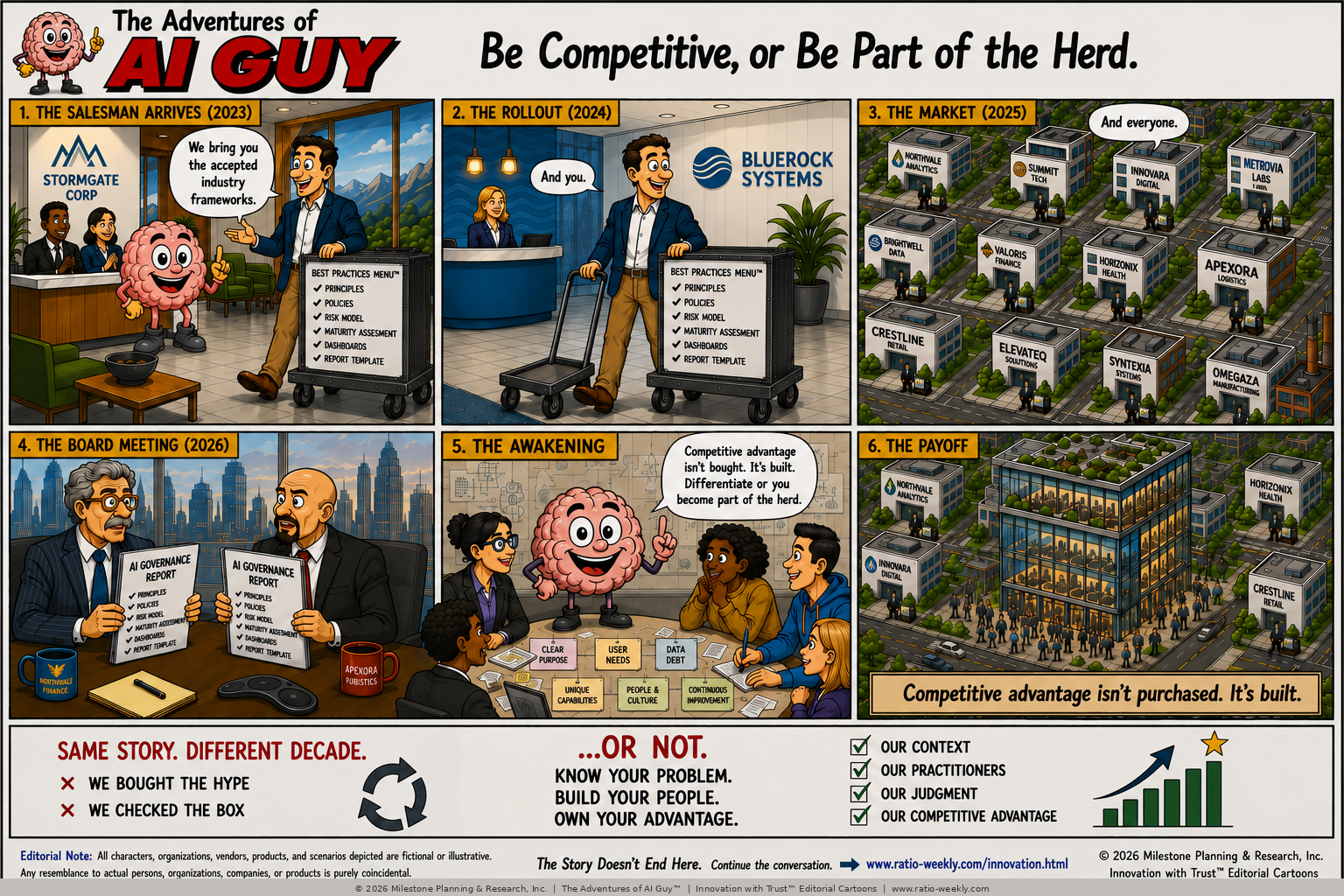
I've watched this pattern repeat for forty years.
The 1980s: TQM, Deming, benchmarking, best-in-class. Every company copying every other company. The quality era was built on eliminating variance -- which is exactly right when you're talking about defects, and exactly wrong when you're talking about strategy.
The 2000s: ERP. Undeniably these systems delivered real efficiency benefits -- but the unanticipated consequences were equally real. Vendors promised companies would retain their "secret sauce." They often didn't. The implementation logic of standardized systems engineers out the very uniqueness that creates competitive advantage. And in the process, many organizations locked themselves into a single vendor, quietly surrendering control of their own future.
Today: AI frameworks, governance checklists, maturity models, best practices menus. Same promise. Same risk. Deming was right that variability is the enemy of quality control. But variability is also the source of innovation, creativity, and competitive differentiation. When an entire industry eliminates variance in pursuit of best practices, it produces something worse than inefficiency -- it produces homogeneity.
AI gives organizations a genuine opportunity to restore their uniqueness. But only if they build their own capability rather than rely solely on someone else's framework.
My technical papers make this case with data and models -- but not everyone reads technical papers. This series is for everyone else.
That's not a consulting pitch. It's a pattern I've watched repeat for forty years.